


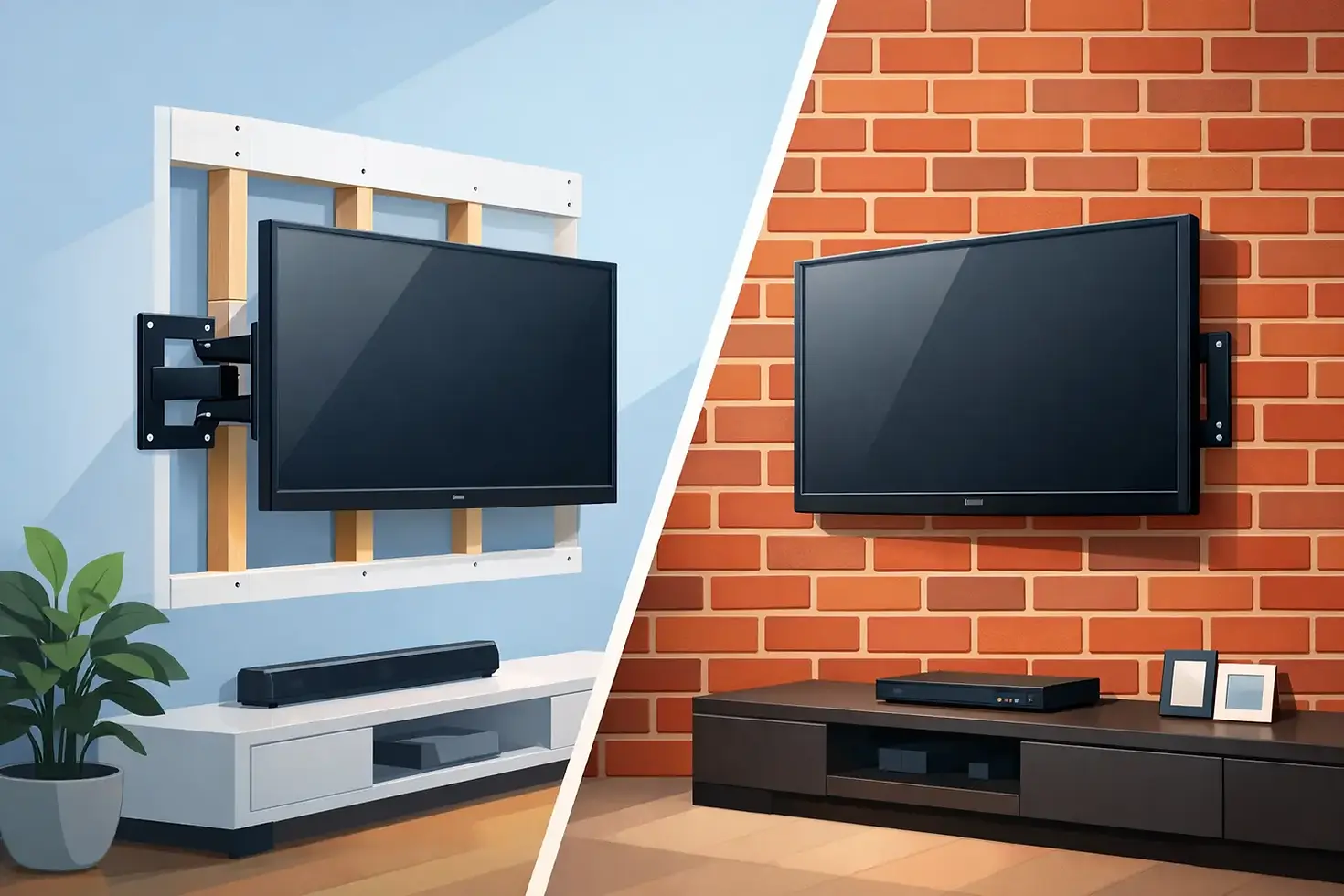
Plasterboard Versus Brick TV Mounting

A TV that looks perfectly safe on the wall can still be badly mounted underneath. That is usually where the real difference in plasterboard versus brick TV mounting shows up - not in how it looks on day one, but in how well it holds over time, especially with larger screens and moving brackets.
For most homeowners, the main question is simple. Is plasterboard safe for a TV, or is brick always the better option? The honest answer is that both can work very well, but they do not work the same way. The wall type changes the fixings, the bracket choice, the weight limits, the cable route and sometimes the best position for the screen.
Plasterboard versus brick TV mounting - what changes?
Brick is usually the more straightforward wall to trust. It gives you a solid base, strong anchor points and less movement once the bracket is fixed properly. For a fixed bracket or a tilting bracket, solid brick or concrete is often the simplest type of installation.
Plasterboard needs more judgement. Not all plasterboard walls are equal. Some are dot and dab over brick, some are stud walls, and many new build homes have plasterboard partitions that feel solid enough until you start thinking about the force a TV bracket puts on them. A 55-inch TV on a slim fixed bracket is one thing. The same TV on a full motion arm that pulls forward and swings left or right is another.
That is why plasterboard mounting is not just about the TV weight printed on the box. It is about leverage, the structure behind the board and whether the load is being spread properly.
Mounting a TV on brick walls
Brick walls are normally the more forgiving option, provided the brick is sound and the right fixings are used. A proper installation will usually involve drilling into the masonry itself, setting suitable heavy-duty fixings and making sure the bracket is level and tightened correctly.
The biggest advantage with brick is stability. Once fixed, the bracket has very little give. That matters if you are mounting a larger TV or using an articulated arm, because the wall needs to cope not only with weight but also with outward pull.
There are still trade-offs. Brick takes longer to drill, creates more dust and can be awkward if the wall is old, crumbly or lined with plaster that hides the true condition underneath. Cable chasing is also a bigger job in masonry than in plasterboard, so if you want a very clean finish with hidden cables, the labour can increase.
Even so, if you have a solid brick or concrete wall in a lounge or bedroom, it is often the most straightforward route to a secure result.
When brick is the better choice
Brick usually comes into its own when the TV is large, the bracket has an extending arm, or the wall needs to cope with regular movement. It also suits rooms where you want long-term confidence and do not want to be limited by stud positions.
If the viewing position is awkward and the screen needs to pull out or turn, brick gives you more flexibility. You are not relying on a small section of wall structure in the same way you often are with plasterboard.
Mounting a TV on plasterboard walls
Plasterboard can absolutely hold a TV, but the method matters far more. The first thing to establish is what is behind it. If it is a stud wall, the safest mounting point is usually into the timber or metal studs, with the bracket chosen to suit the stud spacing and the size of the TV. If it is dot and dab plasterboard over masonry, the installation may need specialist fixings that bridge the gap and secure properly into the solid wall behind.
This is where many DIY jobs go wrong. People assume plasterboard fixings alone are enough because the TV feels light when lifted by hand. But once a bracket is attached, especially one that extends away from the wall, the force on the fixings increases. The plasterboard face can become the weak point if the load is not transferred correctly.
New build homes are a common example. The walls look clean and modern, but that does not automatically mean every position is suitable for a TV. Stud location, wall depth and fixing type all need checking before drilling starts.
Plasterboard is not one single wall type
This is worth stressing because it causes a lot of confusion. A plasterboard wall might mean a hollow stud partition between rooms, or it might mean plasterboard stuck onto blockwork or brick. Those are two very different mounting jobs.
A stud wall often needs the bracket centred on studs or supported with a wider mounting solution. A dot and dab wall may allow stronger masonry fixing behind the board, but only if the cavity and the plasterboard thickness are accounted for properly. Treating both the same is where poor installs happen.
Bracket choice matters just as much as wall type
When comparing plasterboard versus brick TV mounting, the bracket is part of the equation. A fixed low-profile bracket places less strain on the wall because the TV sits close to the surface. A tilting bracket adds a little more force but is still manageable on many wall types.
A full motion bracket is where things become more demanding. The moment the TV is pulled forward, the weight is no longer sitting tight to the wall. The fixing points are under much more stress. That is why a wall that is fine for a fixed bracket might not be the right candidate for an articulated arm.
For many households, the best answer is not just asking whether the wall is plasterboard or brick. It is asking what style of bracket the room actually needs. Sometimes keeping the TV flatter to the wall is the safer and tidier option.
What affects safety most?
The safest TV mounting jobs come down to a few practical checks. Wall structure is first. After that comes TV size and weight, then bracket type, then the quality of the fixings and the accuracy of the installation.
Position also matters. A mount above a fireplace, in an alcove or on a chimney breast can introduce extra issues such as heat, uneven surfaces or awkward drilling angles. In some rooms, the ideal viewing height conflicts with the strongest fixing point, so there may need to be a compromise between layout and structure.
This is where experience saves time. A good installer is not just drilling where the customer points. They are checking what the wall can actually take and adjusting the plan before there is a problem.
Cost differences between plasterboard and brick
People often expect brick to cost more because it is harder to drill. Sometimes it does, especially if the wall is dense concrete or if hidden cables need to be chased in. But plasterboard can also be more involved if stud finding, specialist fixings or reinforcement are needed.
In practice, the price depends less on the label of the wall and more on the complexity of the job. A simple fixed bracket on a clean brick wall may be quicker than a difficult plasterboard install where the studs are in awkward positions. On the other hand, a straightforward stud wall with easy access can be fast and tidy.
That is why quotes should be based on the actual wall and bracket combination rather than assumptions.
Which wall type is better overall?
If you want the short answer, brick usually gives more margin for error and greater flexibility. It is the easier wall type to trust for large TVs and moving brackets. But that does not mean plasterboard is second best across the board.
A properly assessed plasterboard wall can hold a TV securely and neatly, and in many modern homes it is the only realistic option in the chosen room. The key is using the right fixing method for the exact wall construction, not taking a one-size-fits-all approach.
For households in London, Essex and Kent, that matters because housing stock varies so much. Victorian brick walls, 1930s terraces, new build stud partitions and dot and dab interiors all turn up within the same week. What works in one property may be wrong in the next.
We Fit All handles this kind of work every day, so the focus is always on the real structure behind the surface, the bracket being used and the safest way to leave the job solid, level and tidy.
If you are choosing between a plasterboard wall and a brick wall for your TV, do not just pick the one that seems easiest. Pick the one that suits the size of the screen, the bracket you want and the way you actually use the room. A good mount should feel boring once it is done - no movement, no worry, and no reason to think about it again.


Comments